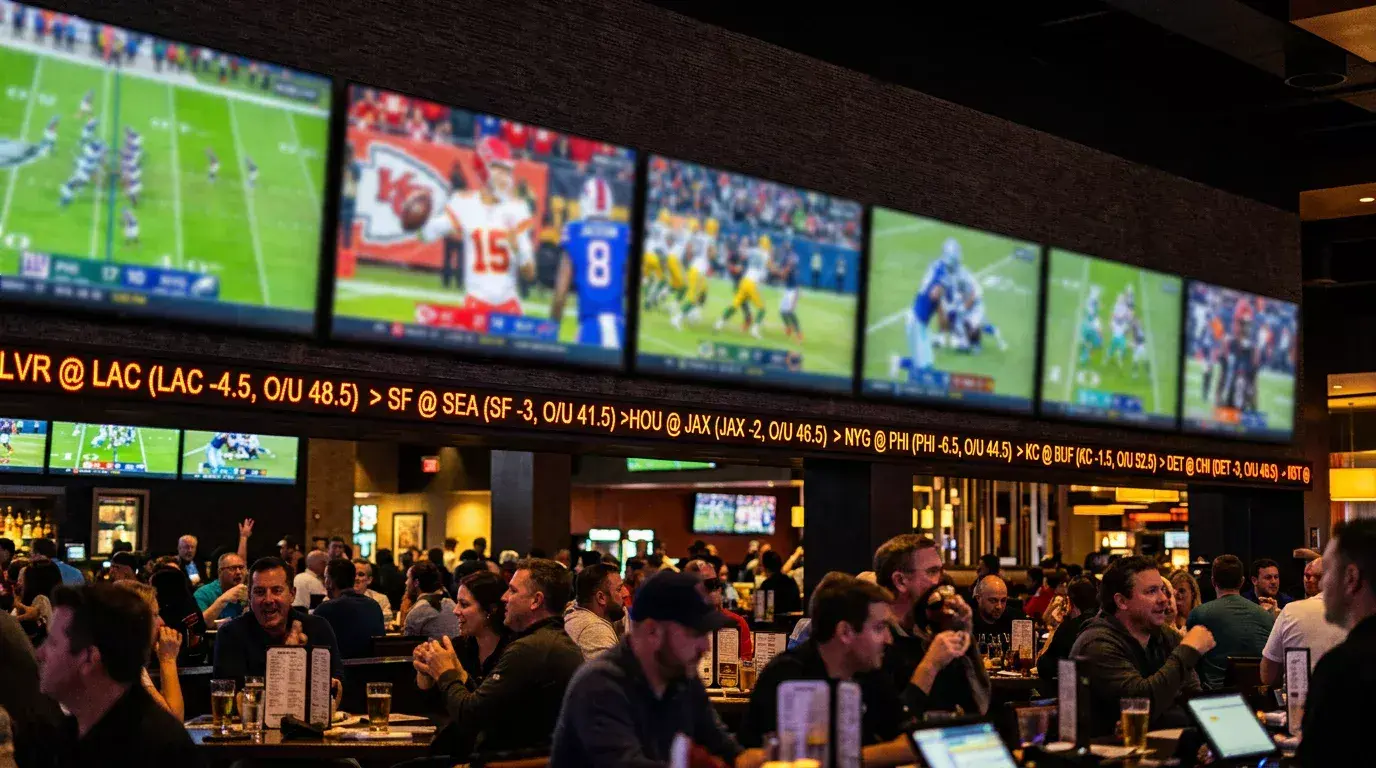
The Fastest-Growing Corner of the NFL Betting Market
Three years ago, in-play betting accounted for roughly 20% of NFL handle at most US sportsbooks. By the 2025 season, that figure had climbed past 30% at several major operators, and Genius Sports CEO Mark Locke has spoken publicly about the drive to bring in-play NFL wagering closer to the 70%—80% levels that European football has maintained for years. The gap between where NFL live betting is and where the industry wants it to be represents the single largest growth opportunity in American sports wagering.
For UK bettors, this trajectory is less surprising. In-play betting on football has been the dominant wagering format in Britain for over a decade, and British punters approach NFL live markets with the same instincts they apply to Premier League matches. The difference is that NFL live betting is structurally more challenging than football live betting — the stoppages, the complexity of scoring, and the asymmetric nature of American football possessions create a pricing environment that is harder for both oddsmakers and bettors to navigate in real time.
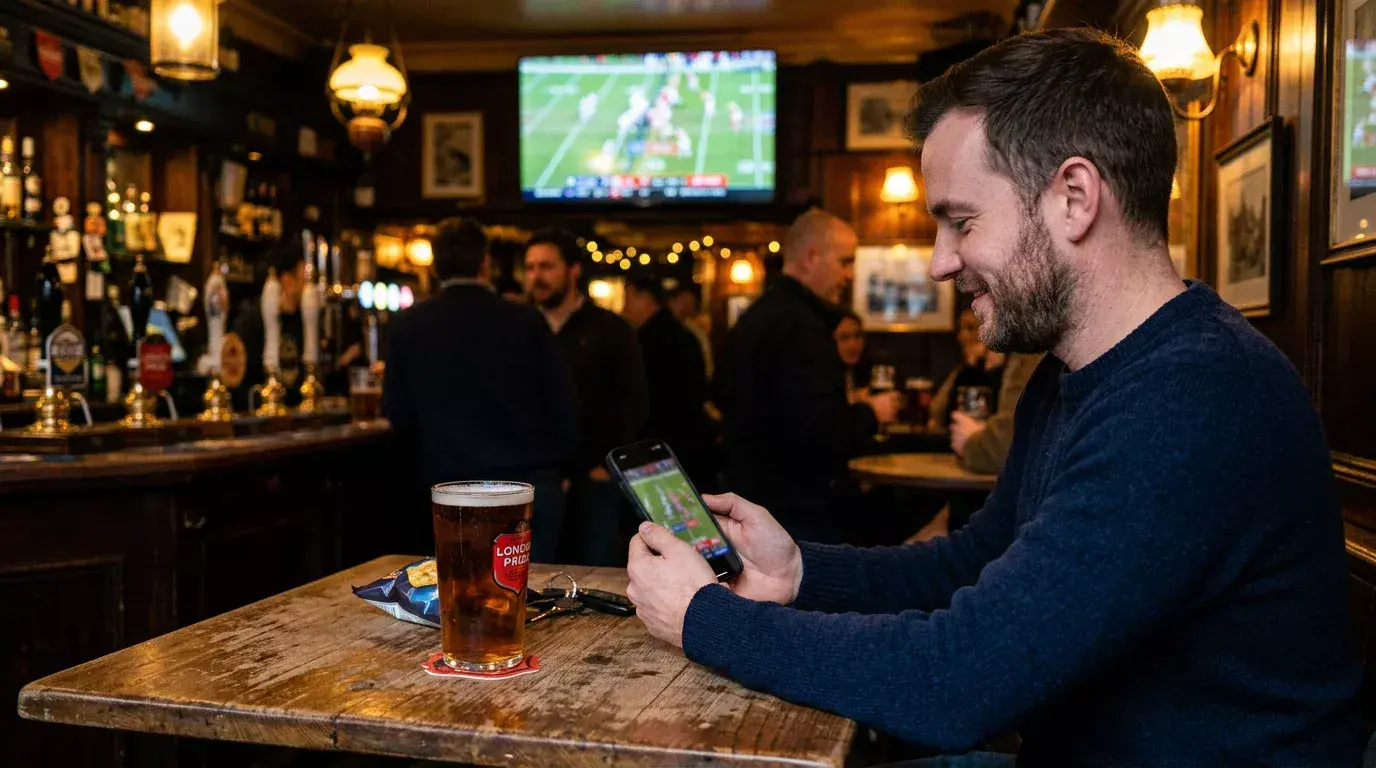
See also: NFL mobile betting trends in the UK for on-the-go wagering.
How NFL In-Play Odds Are Set and Where They Break Down
NFL live odds are generated by algorithmic models that process a continuous stream of inputs: current score, time remaining, down and distance, field position, timeouts remaining, and pre-game power ratings. These models are sophisticated, but they have known limitations that create windows of opportunity.
The most exploitable limitation is the model’s reliance on pre-game power ratings as the baseline. If a team was rated as a 3-point favourite before kickoff and falls behind 14-0 in the first quarter, the live model adjusts the spread but anchors partially to the pre-game assessment. The model treats the 14-point deficit as partially a result of variance — bad luck, a turnover, a special-teams breakdown — and partially as evidence that the trailing team is worse than expected. In practice, the model tends to overweight the pre-game rating and underweight the in-game evidence, particularly in the first quarter when the sample of in-game data is smallest.
This creates a bias: teams that fall behind early are priced more favourably in the live market than their in-game performance warrants, because the model is slow to abandon its pre-game assessment. For a disciplined bettor who watches the game and recognises when a deficit is driven by repeatable factors — a quarterback playing poorly, a defensive scheme being exploited systematically — the live spread on the leading team can offer genuine value.
Scoring Volatility and the Momentum Trap
The biggest mistake I see in NFL live betting — and one I have made myself more times than I care to count — is chasing momentum. A team scores 14 unanswered points, the broadcast narrative shifts to “this team has seized control,” and the live bettor jumps on the bandwagon. The live spread moves 3—4 points in the scoring team’s favour within minutes. Then the other team drives 75 yards for a touchdown on the very next possession, and the momentum narrative reverses.
NFL games are not momentum sports in the way that tennis or basketball are. Possession changes are abrupt, scoring drives can start from any field position, and defensive adjustments happen at halftime with a regularity that disrupts first-half trends. The live market prices momentum because bettors demand it — recreational in-play bettors disproportionately back whichever team scored most recently — but momentum-based pricing creates value on the team that just conceded, not the one that just scored.
The data supports this. Over the 2025 season, the team that scored the most recent touchdown was bet at elevated rates in the live spread market within five minutes of the score. The team on the other side of that bet — the one that just conceded — covered the live spread at approximately 53%—54% in those same windows. The edge is small but persistent, and it stems from the same public-bias dynamic that drives pre-game favourite overvaluation, compressed into a five-minute window.
Halftime Betting: The Structured In-Play Opportunity
If live betting during game action is reactive and chaotic, halftime betting is its disciplined counterpart. The halftime line is set based on the first-half result, the pre-game power rating, and historical second-half scoring patterns. Unlike mid-game live odds that update every few seconds, the halftime line sits for 15—20 minutes, allowing the bettor to analyse without time pressure.
One pattern I have found consistently profitable: second-half unders in games where the first-half total significantly exceeded the first-half line. When a game goes 24-21 at halftime with a full-game total of 44.5, the second-half total is typically set around 21.5—23.5 to account for the expected regression. But the regression is usually more severe than the second-half line implies. Defensive adjustments at halftime are a real and measurable phenomenon — second-half scoring rates are lower than first-half scoring rates across the NFL, and in games where the first half was unusually high-scoring, the regression toward lower second-half scoring is amplified.
For UK bettors timing their involvement with NFL games that kick off at 6:00 PM or 9:25 PM on Sundays, halftime provides a natural entry point. The first half has produced data, the halftime line is available for deliberate analysis, and the over-under statistics for the full season provide the baseline context needed to evaluate second-half totals.
See also: nfl betting statistics — live betting.
Why In-Play Discipline Matters More Than Pre-Game Analysis
The hold rate on NFL live betting is higher than on pre-game markets. Sportsbooks widen the vig on in-play spreads and totals to compensate for the pricing uncertainty, and the rapid pace of in-play wagers means the cumulative vig adds up faster. A bettor who places twenty live bets per game week at a 6% vig is paying significantly more in theoretical house edge than one who places four pre-game bets at 4.5% vig.
Discipline means selectivity. The profitable approach to NFL live betting is not to bet continuously throughout every game but to identify two or three specific situations per week where the live market has clearly mispriced a spread or total. The situations I target are: teams trailing by 10+ points in the first quarter where the deficit was driven by turnovers rather than sustained offensive failure; second-half unders after high-scoring first halves; and live underdogs immediately after the opposing team has scored, when momentum-driven betting has pushed the spread past fair value. Everything else is entertainment, and I price it as such.