
NFL Totals Betting Starts With Understanding Scoring Cycles
In my second year of serious NFL betting, I went all-in on unders. The logic seemed airtight: defences were improving, rule enforcement had settled down after a spike in offensive penalties, and I’d read three articles insisting that scoring was about to regress. I finished the season down 11 units. The lesson wasn’t that unders were bad — it was that I’d confused a narrative with data, and the data told a completely different story.
NFL scoring doesn’t move in a straight line. It moves in cycles, driven by rule changes, offensive scheme evolution, defensive adaptation, and the constant arms race between coordinators on both sides of the ball. The league averaged fewer than 20 points per team per game in the mid-2000s, climbed past 23 by the mid-2010s, and has fluctuated between 21 and 23 since. Every time the average ticks down, commentators declare that defence is “back.” Every time it ticks up, they credit the new generation of quarterbacks. Neither narrative captures the full picture.
For totals bettors, the cycle matters because sportsbooks set their lines based on recent scoring trends — and recent trends can be misleading when the cycle is about to turn. If the league averaged 22.8 points per team last season and the books open Week 1 totals with that assumption baked in, but the actual average drops to 21.4 by mid-season, every total on the board was set too high for weeks before the market corrected. That correction window is where the value lives.
The total US sports wagering handle hit $165.58 billion in 2025, with NFL accounting for the largest share of any single sport. Totals markets capture a significant slice of that volume because they appeal to bettors who want action on a game without taking a side. You don’t need to know who wins. You just need to know how many points get scored. That simplicity makes totals the second-most popular NFL bet type after the spread, and it’s the market where casual bettors are most likely to bet with their gut rather than with data — which is precisely why it offers persistent edges for anyone willing to dig into the numbers.
See also: NFL referee tendencies and game totals.
League-Wide Over/Under Splits: 2015-2025
Here’s a number that surprises almost everyone I share it with: across the past decade of NFL football, the over and the under have hit at rates so close to even that the difference rarely exceeds two percentage points in any given season. Sportsbooks are remarkably good at setting totals. Their models ingest offensive and defensive efficiency data, pace of play, weather forecasts, injury reports, and historical matchup tendencies, and the closing line — the number available just before kickoff — tends to be accurate within a point or two of the actual combined score.
That said, “close to even” isn’t “exactly even,” and the direction of the lean has shifted over the past decade in ways worth tracking. From 2015 through 2018, unders hit at a slightly higher rate than overs in most seasons. The league was in a transitional phase — the passing revolution had matured, defences were catching up with schematic adjustments, and the scoring average dipped slightly. Totals set off the higher-scoring seasons of 2013-2014 overshot the actual output, giving unders a quiet edge.
That flipped from 2019 through 2021. Rule changes protecting quarterbacks and restricting defensive contact pushed scoring higher. The 2020 season, played in empty or near-empty stadiums, produced some of the wildest individual game totals in recent memory — without crowd noise, offences operated at efficiency levels that caught line-setters off guard early in the year. Overs hit at elevated rates in September and October before the market adjusted.
The 2022 through 2025 window has been the most balanced stretch in the data set. Sportsbooks learned from the post-COVID volatility and improved their early-season models. The over-under split in these seasons has hovered within a point of 50/50, with no consistent lean strong enough to build a blind system around. The edge, as always, lives in the margins — specific teams, specific situations, and specific weather conditions that the league-wide average smooths over.
The underdogs’ dominance against the spread in 2025 had a secondary effect on totals. Games that stay competitive tend to see more scoring in the fourth quarter, as trailing teams abandon conservative play-calling and air the ball out. A season with more competitive games — which is what an underdog-friendly ATS environment produces — tends to nudge the over rate slightly higher. The effect is small, maybe a point or two on the overall split, but it’s one of those cross-market connections that pure totals analysis often misses.
Team-Level Totals Trends in 2025
League-wide averages are useful for context. They’re useless for making bets. The action happens at the team level, where individual offensive and defensive tendencies create totals profiles that diverge wildly from the league mean.
In any given season, you’ll find three to five teams whose games consistently go over the posted total and a similar number whose games consistently go under. The rest cluster around the 50% mark. What separates the outliers isn’t always raw talent. It’s tempo, scheme, and defensive identity.
High-tempo offences that run plays quickly push the total in both directions — more possessions mean more opportunities to score, but also more opportunities for turnovers and failed drives. The net effect depends on whether the opposing defence can force stops efficiently. When a fast-paced offence meets a slow, ball-control defence, the tempo clash often produces a final score that’s difficult to predict from the posted total alone. These are the games where totals lines tend to be least accurate, because the models struggle with mismatched pacing.
Defensive identity matters just as much. Teams built around a dominant pass rush tend to suppress scoring in ways that the totals market doesn’t always price in quickly enough. A defence that generates sacks at an elite rate compresses the opposing team’s time of possession and forces quicker throws, which leads to more incompletions and punts. The effect on the total is cumulative: the defence scores fewer points itself (turnovers notwithstanding), and it prevents the opposing offence from reaching its expected output. Games involving elite pass-rush defences are some of the most reliable under spots in the league, particularly in the early weeks of the season before the market fully adjusts to the defensive unit’s impact.
Conversely, teams with poor secondary play tend to push games over. When a defence can’t cover, every possession turns into a potential scoring drive for the opponent, and the game often devolves into a shootout as the trailing team’s offence speeds up to keep pace. If both teams have weak pass defences, the total can sail past the posted number by double digits. These blowout overs are exciting to watch but risky to bet on, because the market usually identifies and prices in the weakness within a few weeks.
The smartest approach to team-level totals analysis is to track offensive and defensive efficiency on a per-drive basis rather than relying on points per game. Points per game includes garbage time, special teams scores, and defensive touchdowns — all of which inflate or deflate the number in ways that don’t reflect the underlying offensive and defensive quality. Points per drive strips out the noise and gives you a cleaner signal of how a team actually moves the ball and stops opponents from moving it. When two teams with high points-per-drive offences and average defences meet, the over becomes a significantly stronger play than the raw points-per-game numbers would suggest, because the per-drive metric accounts for pace and efficiency simultaneously.
See also: nfl betting statistics — totals data.
Key Totals Numbers: Where Lines Cluster and Why It Matters
If you’ve ever wondered why so many NFL totals are posted at 43.5, 44.5, or 47.5, the answer is the same as with spreads: certain numbers represent natural scoring outcomes more frequently than the rest. In spread betting, the key numbers are 3 and 7 because NFL games are decided by field goals and touchdowns. In totals betting, the key numbers are the combined scores that games land on most often.
The most common combined final scores in the NFL cluster around 37 through 51, with particular density at 41, 43, 44, and 47. These numbers occur frequently because they represent the most likely combinations of individual team scores — a 24-20 game (total: 44), a 27-17 game (total: 44 again), a 23-20 game (total: 43). The number 44 alone accounts for a disproportionate share of combined final scores, which means that totals posted at 43.5 or 44.5 are landing on a razor’s edge.
For bettors, the implication is practical. When a total is posted at a key number — 43.5, 44.5, 47.5 — even half a point of line movement can shift the expected hit rate meaningfully. Shopping for the best number matters on every bet, but it matters most at these thresholds. If one bookmaker has the total at 43.5 and another at 44, that half-point gap represents a real difference in expected value, because so many games land exactly on 44.
Away from the key numbers, totals posted at 38.5 or 52.5 tend to be more stable. Games reaching those extremes are either defensive slogs or shootouts, and the outcome relative to the total is less sensitive to a half-point swing. My approach is to be more aggressive at key numbers — where precision matters — and more selective at the extremes, where the posted total usually has enough cushion that the edge is smaller.
Situational Over/Under Splits: Indoor, Outdoor, Primetime
Every year, someone on a betting forum posts a chart showing that dome games go over at a higher rate than outdoor games. Every year, that chart gets shared thousands of times. And every year, the people acting on it find out that the edge is thinner than the headline number suggests.
It’s true that indoor games produce slightly higher scoring on average. Temperature-controlled environments with no wind favour passing offences, and passing offences generate more points per drive than run-heavy schemes. But sportsbooks know this. They set dome totals higher than outdoor totals by default, which absorbs most of the scoring differential before you even look at the over-under split. The real question isn’t “do dome games score more?” — it’s “do dome games score more than the already-inflated total accounts for?” The answer, in most seasons, is barely.
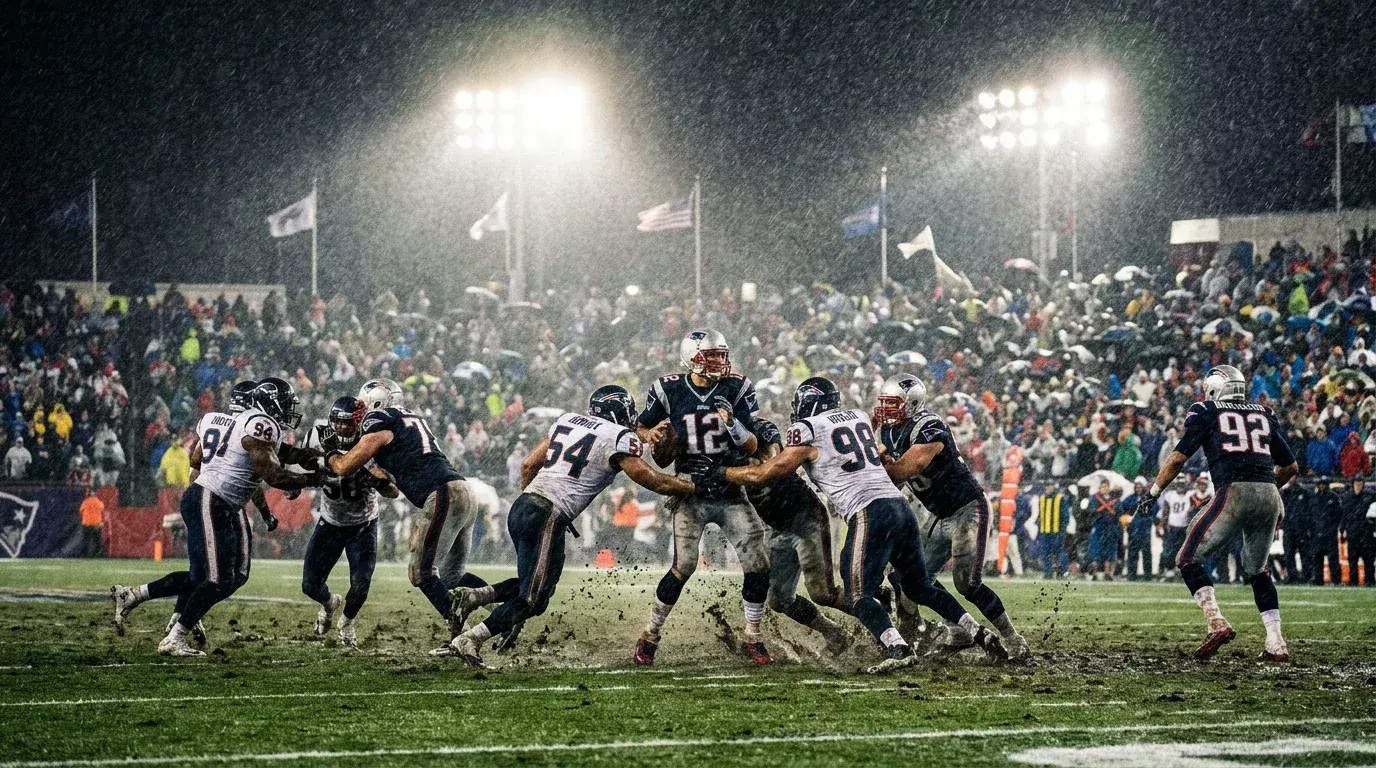
Outdoor games in cold weather tell a more interesting story. When the temperature drops below freezing and wind exceeds 15 miles per hour, scoring suppression becomes severe enough that the market consistently underadjusts. Totals for late-season games in Green Bay, Chicago, and Buffalo are set lower than normal but often not low enough. The passing game suffers disproportionately — grip issues, receiver route-running affected by footing, and quarterback accuracy declining with cold hands all compound to push the actual combined score below even a reduced total. I wrote a full breakdown of the weather impact on NFL totals that covers wind thresholds and precipitation effects in detail.
Primetime games — Monday Night Football, Thursday Night Football, and Sunday Night Football — carry their own totals dynamics. The 2025 International Games on NFL Network averaged 6.2 million viewers, a 32% jump from the previous year, and that audience growth coincides with growing handle on these high-profile slots. Thursday Night Football, in particular, tends to produce lower-scoring games due to the short week. Teams playing on four days’ rest run simpler offensive schemes, rely more heavily on the run game, and commit more pre-snap penalties. The under has historically been a slight lean on TNF, though the market has tightened its pricing in recent seasons.
Sunday Night Football sits at the opposite end. The league’s flex scheduling ensures that the best matchups land in the SNF slot, which means two high-quality offences meeting regularly. Totals are set higher as a result, and the over-under split tends to be close to even because the elevated number already accounts for the offensive firepower. The edge here isn’t in blindly backing overs or unders — it’s in identifying the specific weeks where the flex schedule puts an unexpectedly one-sided matchup into the primetime window, and the total hasn’t adjusted.
Totals Betting at UK Sportsbooks: Format and Market Depth
I placed my first NFL totals bet through a UK bookmaker in 2017, and the experience was jarring. The total was listed as “Over 44.5 Points” with decimal odds of 1.91 — no American odds toggle, no alternate totals, no first-half or quarter breakdowns. The market existed, but it felt like an afterthought compared to the match-result and handicap offerings that UK books prioritise for football and rugby.
That has changed substantially. NFL generates more single-sport handle than any other event in US sports betting, and UK bookmakers have responded to growing demand by expanding their totals coverage. Most UKGC-licensed operators now offer the main game total, first-half totals, team totals, and at least one or two alternate lines above and below the primary number. It’s not yet at the level of a US sportsbook, where you might find 15 alternate totals at various price points, but it’s no longer the barren wasteland it was five years ago.
The odds format is worth understanding if you’re cross-referencing American totals data. A US line of Over 44.5 at -110 translates to decimal odds of approximately 1.91. Under 44.5 at -110 is also 1.91. The combined implied probability exceeds 100% because of the bookmaker’s margin — roughly 4.5% on a standard -110/-110 line. UK books express the same margin through their decimal pricing, and the vig is comparable. Bill Miller, president of the American Gaming Association, described the 2025 season as one where bettors had “more ways than ever to responsibly engage with the game” — and for UK punters, the expanding totals market is one of those ways.
One area where UK bettors should pay attention is line movement timing. US totals lines open on Sunday evening for the following week’s slate and move continuously through the week as money comes in. UK books tend to post their NFL lines later — sometimes not until Tuesday or Wednesday — and their lines often mirror the US closing number from the day before rather than reflecting independent modelling. That lag creates a brief window where sharp US market movement hasn’t yet been absorbed into the UK price. If you’re watching the US market in real time and notice a total drop from 45.5 to 44 on Monday night, checking whether your UK bookmaker is still showing 45 on Tuesday morning is worth the effort.
There’s another practical consideration worth mentioning. Several UK bookmakers now offer “total match points” as a band market — for example, “41 to 50 total points” at enhanced odds. These band bets are popular with recreational punters because the payout looks attractive, but the implied probability is usually worse than taking the straight over or under at the primary line. The margin embedded in band totals tends to be substantially higher than on the main line, and I’d recommend sticking with the standard over/under unless you’ve calculated the implied probability yourself and confirmed the price represents genuine value.
Where the Totals Edge Lives in 2026 and Beyond
The league-wide over-under split is approaching perfect efficiency. That’s not a complaint — it’s a signal to change approach. When the broad market is well-calibrated, the value migrates to the edges: team-level mismatches, weather-affected games, early-season mispricing before the market has enough data to adjust, and key-number sensitivity at 43.5 and 44.5.
My own process starts with three filters. First, I check whether the total sits on or near a key number — if it does, I know that precision matters and I invest more time in the analysis. Second, I check the weather forecast for outdoor games, especially in November through January. Third, I look at the pace-of-play matchup: is a fast-tempo offence facing a slow, grinding defence, or vice versa? Tempo mismatches create uncertainty in the total that the market doesn’t always resolve accurately.
None of these filters produce a guaranteed winner. Totals betting is a grind, not a gold rush. But the bettors who approach it with structured analysis rather than gut feeling — who understand that the over-under split is nearly even by design and that the edge lives in the specifics — are the ones who finish seasons in profit. The data is there. The question is whether you’re willing to let it override the instinct to bet on fireworks every Sunday.