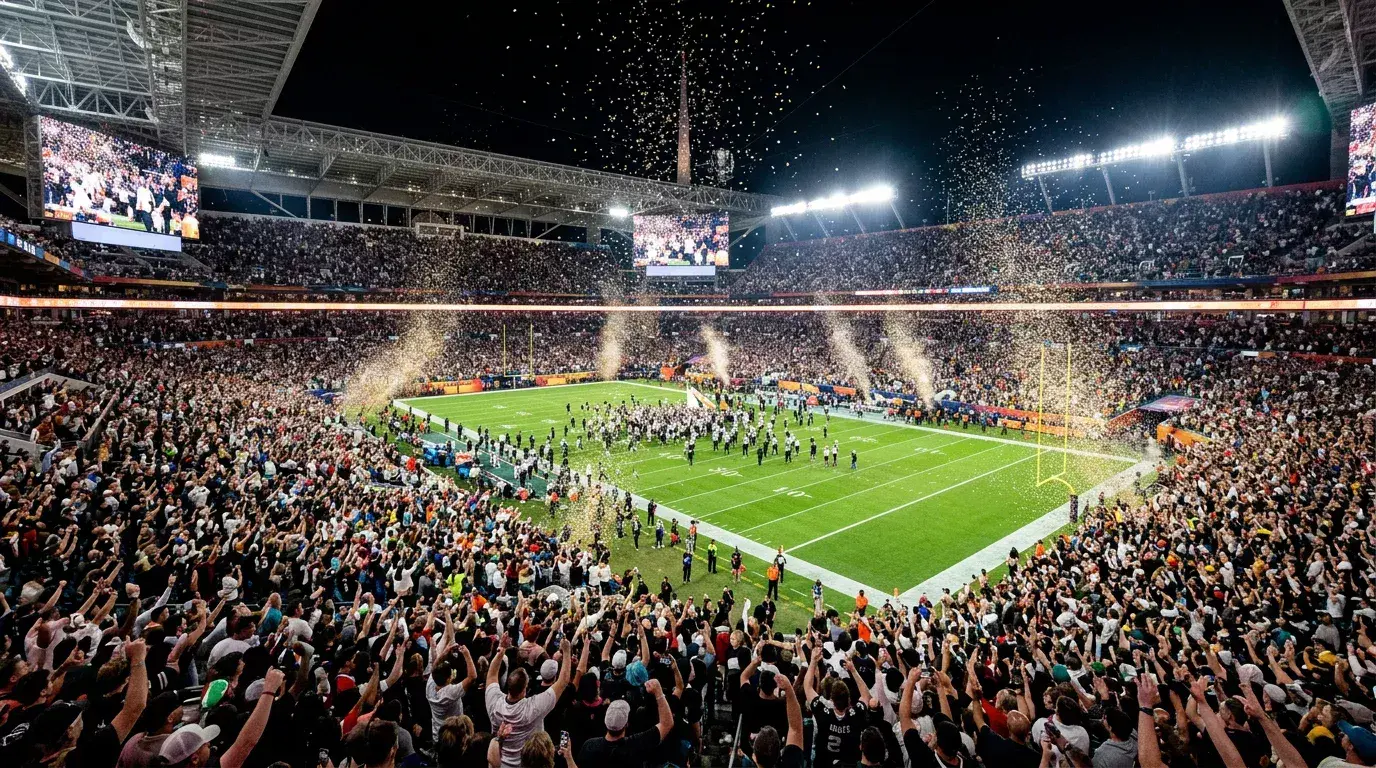
The Biggest Single-Day Betting Event on the Planet
I remember the first Super Bowl I bet on from the UK. It was a Sunday evening, the kickoff was just before midnight London time, and I was sitting in a flat in Shoreditch with three friends who couldn’t name a single player on either roster. They all had accumulators running. One of them had combined “first scorer anytime TD” with the Gatorade colour. None of them had any idea what they were doing, and none of them cared. That’s the Super Bowl: the one day of the year when the entire planet bets on American football, most of them for the first and last time until February rolls around again.
No other single sporting event generates the wagering volume of the Super Bowl. The total legal handle on Super Bowl LIX in February 2025 reached approximately $1.76 billion across US sportsbooks — a figure that doesn’t account for the billions more wagered through legal operators in the UK, Australia, and regulated European markets, nor the unquantifiable offshore and grey-market volume. The NFL’s championship game operates on a different financial scale than any regular-season contest or even any playoff game. It is, by every measurable standard, the peak of the American sports betting calendar.
What makes the Super Bowl unique from a betting-data perspective isn’t just the volume — it’s the composition of that volume. During a regular-season NFL week, the betting handle is dominated by experienced bettors placing spread and totals bets. On Super Bowl Sunday, the market floods with casual money. First-time bettors, once-a-year punters, and people who wandered into a sportsbook because they were at a party all contribute to a handle that’s dramatically more “public” than any other NFL game. That shift in bettor composition changes the way the market behaves, and understanding those changes is the difference between betting the Super Bowl informed and betting it blind.
See also: Super Bowl betting statistics with historical data.
Super Bowl Handle Records: From LIV to LX
The growth trajectory of Super Bowl handle tells the story of legal sports betting’s expansion in the United States more clearly than any other single data point. Super Bowl LIV in February 2020 — the last championship before the COVID-disrupted season — saw a legal handle of roughly $270 million. That number felt enormous at the time. It now looks quaint.
The explosion began in earnest with Super Bowl LVI in 2022, the first championship played after a wave of new states launched legal mobile wagering. The handle cleared $500 million. Super Bowl LVII in 2023 pushed past $900 million. Super Bowl LVIII, the Chiefs-49ers epic in Las Vegas, broke the billion-dollar barrier with an estimated $1.39 billion in legal US handle. And then Super Bowl LIX — Chiefs versus Eagles in New Orleans, February 2025 — pushed the record to approximately $1.76 billion.
That progression — $270M, $500M, $900M, $1.39B, $1.76B in five years — is not a linear growth curve. It’s an acceleration, driven by three forces operating simultaneously. First, state-by-state legalisation keeps adding new markets: each Super Bowl since 2020 has been the first championship available for legal mobile betting in a handful of additional states. Second, operator marketing spend peaks in the weeks before the Super Bowl, with sign-up bonuses, free bets, and promotional offers designed to acquire new customers during the highest-visibility window of the year. Third, the cultural penetration of sports betting continues to deepen. The American Gaming Association noted that 68 million Americans planned to bet on Super Bowl LIX — a participation rate that dwarfs any other single sporting event in the country.
The total US sports wagering handle reached $165.58 billion in calendar year 2025, with gross gaming revenue of $16.80 billion. The Super Bowl alone accounted for roughly 0.8% of annual handle concentrated into a single day — an extraordinary density of wagering activity that creates market dynamics unlike anything else in the NFL calendar.
For the 2026 game — Super Bowl LX, set for February in San Francisco — the handle projection will inevitably target the $1.5 billion mark. Whether it gets there depends on which teams qualify (marquee matchups drive more casual betting), how many new states come online between now and kickoff, and whether the promotional environment remains as aggressive as it has been in recent years. Early signs suggest operator marketing budgets are stabilising rather than growing, which could moderate the growth rate compared to the explosive 2022-2025 window.
The composition of that handle matters as much as the total. Sportsbook executives have noted publicly that the Super Bowl generates a higher ratio of new-account sign-ups to total bets than any other event. A significant portion of the handle comes from bettors who opened their account that same week, placed one or two wagers on the championship game, and may not bet again until the following February. This “annual bettor” cohort behaves differently from the regular NFL bettor base — they bet more impulsively, they gravitate toward props and accumulators rather than straight spreads, and they are less price-sensitive. The industry’s hold rate on Super Bowl Sunday is consistently higher than its hold rate on a typical NFL Sunday, precisely because the marginal bettor on Super Bowl night is less sophisticated than the marginal bettor in Week 7.
Super Bowl Prop Bet Volume and Popularity
If the spread and total are the serious side of Super Bowl betting, props are the party. And the party has grown into something the industry didn’t fully anticipate.
Prop bets — wagers on outcomes other than the final result, such as which player scores the first touchdown, how many passing yards the quarterback throws, or whether the halftime show exceeds a certain length — have exploded in volume over the past five years. Super Bowl prop handle now represents a substantial portion of total Super Bowl wagering, driven almost entirely by casual bettors who find prop markets more engaging and more accessible than traditional spreads and totals.
The appeal is straightforward. You don’t need to understand handicapping or know what -3.5 means to bet on whether a specific player will score a touchdown. It’s a yes-or-no question with a clear narrative hook — the kind of bet you can make at a watch party and track in real time without a statistics degree. That accessibility is also what makes props the highest-margin product on the Super Bowl board. Sportsbooks price player props with margins that often exceed 10-15%, significantly higher than the 4-5% margin on the main spread. The sheer volume of casual money flooding into these markets means the books don’t need to price them tightly. The customers aren’t shopping for the best line on “Kelce anytime TD at +120 vs +115.” They’re placing a bet for the experience, and the price is secondary.
For a more detailed breakdown of prop bet maths and where the margins cluster, I’ve covered the full landscape in the piece on NFL prop bet statistics. The short version: if you’re betting Super Bowl props for entertainment, they’re a blast. If you’re betting them for profit, you’re fighting an uphill battle against some of the widest margins in the market.
The growth of same-game parlays has further accelerated prop volume. SGPs allow bettors to combine multiple prop selections from the same game into a single wager, and the Super Bowl is the single biggest SGP event of the year. When a casual bettor builds a five-leg SGP combining a spread pick, an over/under pick, and three player props, the sportsbook’s cumulative margin on that combination can approach 30% or more. Operators love this product. Their earnings calls for the first quarter consistently highlight Super Bowl SGP revenue as a key driver, and the promotional push around “build your own bet” features intensifies every January.
Super Bowl Wagering Beyond the United States
The American sports betting industry tends to discuss the Super Bowl as a domestic phenomenon. Walk into any sportsbook in London on the Monday morning after the game and you’ll find out how wrong that framing is.
Global Super Bowl wagering is impossible to quantify precisely because most international markets don’t report handle data at the event level. What’s clear from operator commentary and market growth figures is that the Super Bowl is the single largest American-sport betting event outside the US, and the gap between it and the second-largest (likely the NBA Finals or the College Football Playoff) is enormous.
In Australia, the Super Bowl has become a fixture on the betting calendar despite the brutal timezone — kickoff typically falls on a Monday morning. Australian licensed operators run Super Bowl-specific promotional campaigns that rival their Melbourne Cup offerings. The cultural crossover between Australian rules football, rugby, and NFL has created a bettor base that understands spreads and totals intuitively, making the transition to Super Bowl wagering relatively seamless.
In Europe, the UK leads by a wide margin. The NFL’s investment in the London Games — now a permanent fixture on the international calendar — has built a British fanbase large enough to sustain serious commercial interest from UKGC-licensed operators. Entain’s data showing a 65% year-on-year increase in British and Irish NFL bettors captures the overall growth, but the Super Bowl spike sits on top of that baseline. For many UK bettors, the Super Bowl is their entry point into NFL wagering, and a meaningful percentage of them continue placing bets on regular-season games the following autumn. The Super Bowl functions as a customer acquisition event for NFL betting in the UK, much as it does domestically for US sportsbooks.
Germany, Scandinavia, and Japan represent emerging Super Bowl wagering markets, though their volumes remain small compared to the UK and Australia. The expansion of NFL International Games to new host cities — Berlin, Madrid, Sao Paulo — is cultivating fanbases that will eventually translate to betting handle. The trajectory is clear even if the timeline is uncertain: the Super Bowl’s wagering footprint is globalising, and the markets that embrace it earliest will shape how the event is consumed by bettors for decades to come.
The NFL itself has embraced this globalisation. The 2025 International Games averaged 6.2 million viewers, a 32% increase from the previous year, and the league’s media rights deals now include provisions for international streaming that would have been unthinkable a decade ago. Every new viewer in London or Frankfurt or Tokyo is a potential bettor, and the operators understand this. The Super Bowl sits at the apex of a funnel that starts with casual international viewership, moves through regular-season engagement, and converts a growing percentage of fans into active bettors. The $1.76 billion US handle is the visible peak of an iceberg whose submerged global mass is expanding year on year.
See also: nfl betting statistics — Super Bowl hub.
How UK Bettors Engage With the Super Bowl
Last February I watched the Super Bowl at a pub in Manchester that had set up three screens, imported American snacks, and hired a DJ to play music during timeouts. The bar was rammed. Half the crowd were checking their phones every play — not for social media, but for their bet trackers. The Super Bowl has become a genuine UK cultural event, and the betting is now inseparable from the experience.
Fifteen percent of men and 4% of women in Britain bet on sports, and the Super Bowl captures attention from both habitual and occasional bettors. The late kickoff time — typically between 23:00 and midnight GMT — doesn’t suppress participation the way you might expect. If anything, it enhances the event’s appeal as a special occasion: this is not a quick bet placed during a Saturday afternoon football accumulator. It’s a deliberate choice to stay up, order food, and turn a single game into a four-hour social event. The demographics skew young: 76% of UK bettors aged 18-24 place their wagers via mobile, and Super Bowl Sunday is one of the peak nights for mobile sports betting activity across UKGC-licensed platforms.
The markets that UK bettors gravitate toward on Super Bowl night diverge from the US pattern. American casual bettors tend to start with the spread or moneyline and add props as secondary bets. UK bettors, accustomed to the accumulator culture of football betting, are more likely to build multi-leg accumulators combining the match result, player props, and game specials. The “build your own bet” feature — essentially a rebadged same-game parlay — is prominently marketed by UK operators in the weeks before the Super Bowl, and uptake is high.
The regulatory environment shapes the experience. UKGC-licensed operators are required to display responsible gambling messaging, enforce affordability checks for larger deposits, and restrict certain types of promotional offers that their US counterparts use freely. The result is a slightly more measured Super Bowl betting environment in the UK compared to the US, where sportsbook promotions are aggressive and sign-up bonuses can be worth hundreds of dollars. UK bettors face tighter guardrails — but the core engagement with the game, the bets, and the social experience is remarkably similar on both sides of the Atlantic.
Line Movement and Market Efficiency on Super Bowl Sunday
Here’s something that surprises bettors who only pay attention to the NFL during the Super Bowl: the championship game is the least efficient betting market on the NFL calendar. That sounds counterintuitive — surely the most-watched, most-analysed game of the year should produce the sharpest lines? But the opposite is true, and the reason is the composition of the money.
During a regular-season NFL week, the betting market is dominated by repeat bettors who have established accounts, understand line movement, and place wagers based on some form of analysis. The sportsbook’s closing line is calibrated by this informed money, and the result is a highly efficient market where the closing spread predicts the outcome within a few points more often than not.
On Super Bowl Sunday, that calibration breaks down. Tens of millions of casual bettors enter the market, many of them placing their first sports wager of the year. Their money is not informed by models or data — it’s informed by brand loyalty, recent narrative, media coverage, and which team their friends are backing. This flood of recreational money pushes the line in whichever direction the public leans, and the lean is almost always toward the more popular team, the more famous quarterback, or the franchise with the larger national following.
Sportsbooks are aware of this and respond strategically. Rather than fighting the public money, they shade the line toward the popular side, knowing that the casual flood will keep the action coming regardless of a half-point or full-point move. This creates a situation where the Super Bowl spread is, on average, less accurate than a regular-season spread — it’s inflated toward the public side, which opens potential value on the less popular team.
Historical Super Bowl ATS data supports this. Underdogs have covered the spread in the majority of Super Bowls over the past two decades, and the trend has intensified in the mobile betting era as casual handle has grown. The sample size is small — one game per year — so the statistical confidence is limited. But the mechanism is clear: a market flooded with uninformed money will misprice the spread in the direction of that money, and the contrarian side benefits. The bettors who treat the Super Bowl as the most recreational-heavy, public-money-saturated event of the year — and adjust their approach accordingly — are the ones who extract the most value from the biggest betting day on the calendar.