
The Bet That Funds the Sportsbook
Last season, a friend showed me his betting account history with obvious pride. Three parlay wins in six weeks, each paying between 8/1 and 15/1. His face told me he thought he had cracked the code. His account balance told a different story — down 30% on the year despite those headline wins. That is the parlay trap in miniature: the wins are spectacular enough to create a narrative of success while the cumulative losses quietly erode the bankroll beneath the surface.
Parlays are the engine of sportsbook profitability. The industry hold rate on NFL wagering reached 10.15% in 2025 across $165.58 billion in total US handle, and multi-leg bets are the primary driver of that figure. Standard spread bets carry a theoretical hold of 4.5%—5%. Parlays carry effective hold rates of 15%—30% depending on the number of legs, because the payout structure systematically undercompensates for the compounding probability of winning multiple independent events.
See also: NFL same game parlay win rate statistics.
Win Rates by Number of Legs
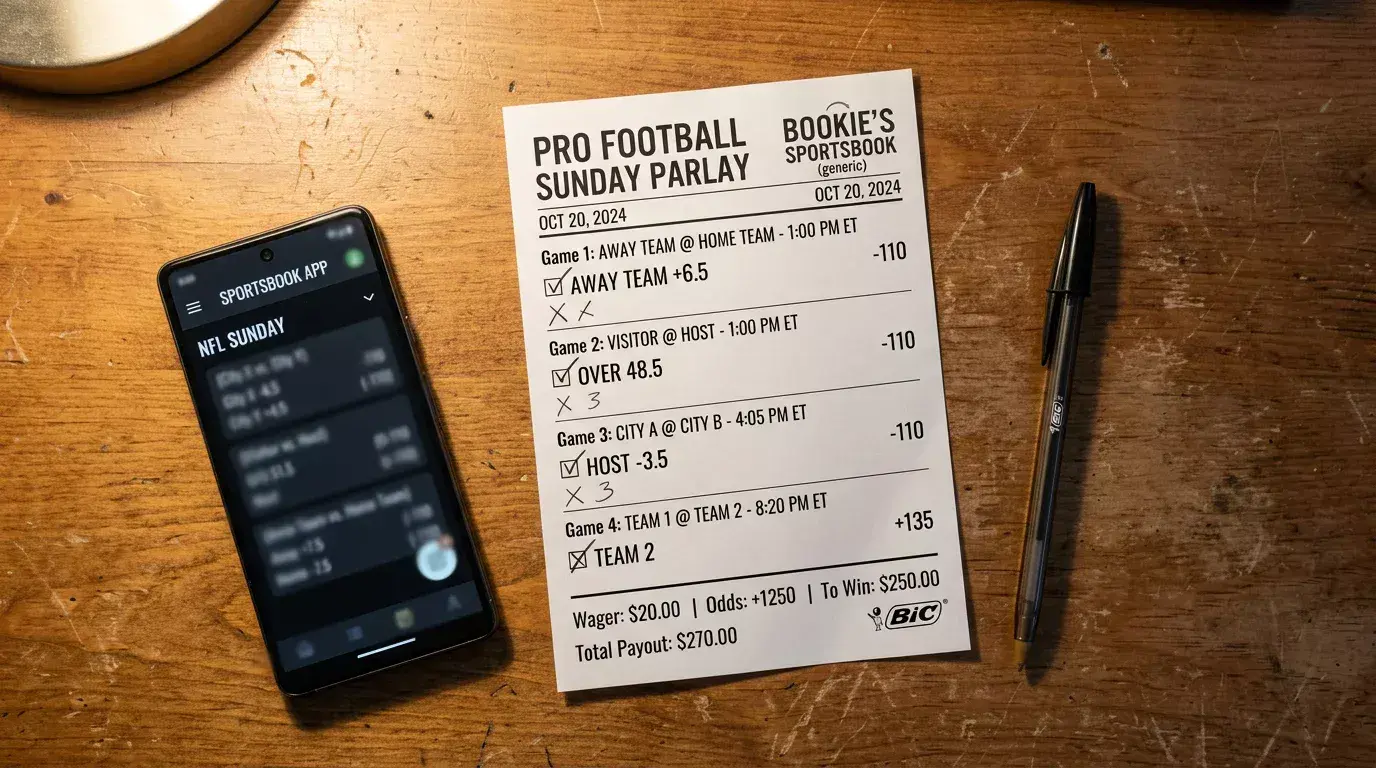
The mathematics of parlays are straightforward, and they are not kind to the bettor. A two-leg parlay on two -110 spread bets has a true probability of winning approximately 25% (0.50 x 0.50, assuming each leg is a coin flip). The standard payout for a two-leg parlay is 2.6/1, which implies a break-even win rate of 27.8%. The gap between the true 25% win probability and the 27.8% break-even point is the house edge — approximately 10% on a two-leg parlay.
That edge compounds with each additional leg. A three-leg parlay wins approximately 12.5% of the time; the standard payout of 6/1 implies a break-even of 14.3%. A four-leg parlay wins approximately 6.25%; the payout of 10/1 to 12/1 implies a break-even of 8.3%—9.1%. By the time you reach six legs, the true win probability is roughly 1.5%, and the house edge exceeds 30% in most payout structures. These numbers are not approximations or theoretical constructs — they are the mathematical reality that governs every parlay ticket.
UK bettors encounter parlays under the term “accumulator” or “acca,” and the payout structures at British operators differ slightly from US books. UK accumulators typically multiply the decimal odds of each leg, which can produce marginally better payouts than the fixed payout grids used by many US sportsbooks. The difference is small — perhaps 0.1 to 0.3 points of expected value on a four-leg accumulator — and does not fundamentally change the negative expected value of the bet.
Why Sportsbooks Love Parlays and What That Tells You
Entain’s financial disclosures are instructive. The company reported 60% year-on-year growth in NFL bet count and 46% growth in staking, with prop stakes surging 90% year over year. A substantial portion of that growth is parlay-driven — same game parlays, multi-sport accumulators, and player prop parlays that combine three to six legs into a single ticket with a headline payout that captures the bettor’s imagination.
When an entire industry builds its product strategy around a single bet type, that bet type is profitable for the house. Sportsbooks promote parlays aggressively because the hold rate is dramatically higher than on straight bets. The promotional infrastructure — parlay insurance, profit boosts on 4+ leg accas, social media sharing of parlay wins — exists to drive volume toward the highest-margin product. Every “free” parlay boost or insurance offer is funded by the enormous house edge on the parlays that the promotions are designed to encourage.
This does not mean parlays are inherently foolish. It means that any parlay strategy must be evaluated against the specific house edge it faces, and the bettor must understand that the product is designed to extract more value per pound wagered than any other bet type available.
See also: nfl betting statistics — parlay EV.
A Rational Framework for Using Parlays
If parlays carry a negative expected value — and they do — why would any informed bettor use them? The answer is bankroll utility. A bettor with a small bankroll who identifies two high-confidence plays faces a choice: bet each one individually for a small return, or combine them in a parlay for a larger return from the same total outlay. The parlay sacrifices expected value for increased variance, which can be rational for a bettor whose bankroll constraint limits the impact of individual straight bets.
The rational approach caps parlay usage at two to three legs, where the house edge is lowest. Two-leg parlays at 10% house edge are not dramatically worse than a standard spread bet at 4.5% — the incremental cost per leg is approximately 5%, which is the price of the leverage. Three-leg parlays push the cost higher but remain within a range that an informed bettor can accept consciously. Beyond three legs, the house edge escalates to levels that no amount of handicapping skill can overcome over a meaningful sample.
I allocate no more than 10%—15% of my weekly NFL stake to parlays, and those parlays are exclusively two-leg combinations of my highest-confidence spread plays. I do not build SGPs for entertainment during games. I do not add a third or fourth leg to chase a higher payout. The discipline is in treating the parlay as a tool with a known cost — not as a lottery ticket dressed up in football terminology.