
The Longest Hold in Sports Betting
A mate of mine placed a Super Bowl futures bet on the Cincinnati Bengals in March 2022 at 60/1. By January 2023, they were in the AFC Championship Game. He did not cash out. They lost. His ticket was worthless by February, and the sportsbook had held his money for eleven months before keeping it. That is the futures market in a nutshell — the longest capital lock-up in sports betting, with the highest house edge, and the most emotionally compelling narrative for the punter.
NFL futures generate enormous handle precisely because they appeal to the fan-bettor overlap. Every supporter believes their team has a path to the Super Bowl in March. That optimism translates to wagering, and sportsbooks capture it at margins that dwarf game-day spreads and totals. The hold rate on NFL futures routinely exceeds 25%, compared to the 4%—5% vig on a standard point spread bet. For the $165.58 billion US handle processed in 2025, futures represent one of the most profitable market segments per dollar wagered.
See also: NFL Draft betting markets as a key futures window.
Super Bowl Odds: How the Market Moves from March to February
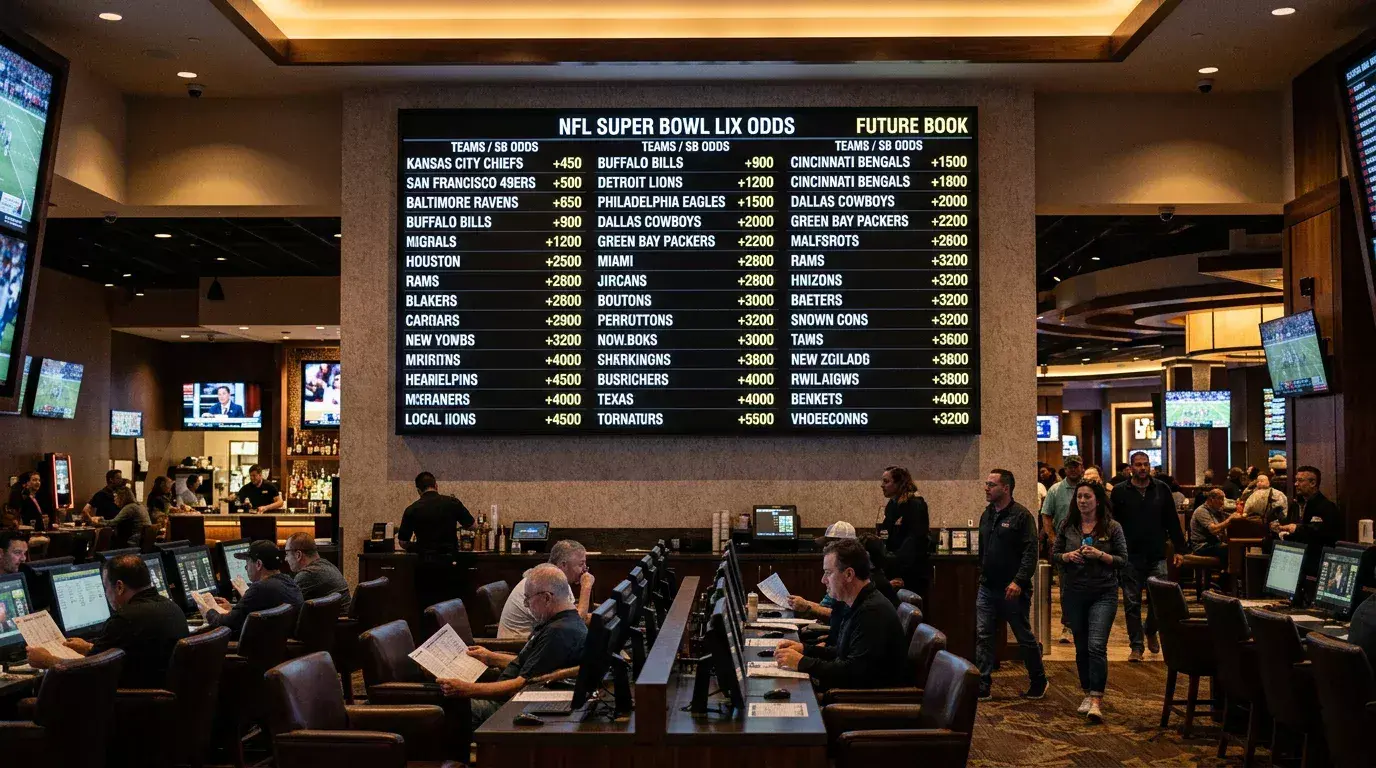
Super Bowl futures open within days of the previous championship game, and they move continuously for the next twelve months. The opening prices reflect a blend of current roster strength, expected free-agency and draft activity, and the market’s assessment of coaching quality. By Week 1 of the regular season, the prices have already shifted substantially — typically 30%—40% of the total price movement has occurred before a single game is played.
The value window is narrowest at the extremes. The preseason favourite is almost always overbet by the public, which compresses the odds below their true probability. The long shots at 200/1 or higher are underbet in volume but overpriced in probability — the implied chance of a 200/1 team winning the Super Bowl is 0.5%, and the actual historical hit rate for teams in that price range is closer to 0.1%. The middle tier — teams priced between 15/1 and 40/1 — is where the most empirical value has existed over the past decade. These are playoff-calibre squads with a plausible but not obvious path to the championship, and the market occasionally underprices their chances.
In-season futures movement creates a second opportunity. A team that starts 1-3 sees its Super Bowl odds lengthen dramatically, often beyond what the four-game sample justifies. I have tracked in-season futures value since 2020, and the pattern is consistent: buying teams after a slow start — provided the underlying talent and coaching staff remain intact — has produced positive expected value over a multi-year sample. The market overreacts to early-season results because casual bettors abandon ship and sportsbooks adjust prices to reflect the changed flow of money.
Season Win Totals: The Market’s Most Efficient Futures Bet
If Super Bowl futures are the splashiest futures bet, season win totals are the most analytically tractable. A team’s win total is set by oddsmakers in the offseason — typically between 6.5 and 12.5 — and the bettor wagers on whether the team will exceed or fall short of that number over the 17-game regular season.
Win totals are priced more efficiently than Super Bowl odds because the outcome is less binary and the sample size is larger. A team does not need to win a championship to cash a win-total over; it needs to win one more game than the number suggests. This makes the market more amenable to systematic analysis: power ratings, strength-of-schedule models, and historical regression patterns all produce actionable projections that can be compared to the posted numbers.
The edges are small but real. Over the past five seasons, the average absolute deviation between posted win totals and actual wins has been approximately 2.5 games. That means the market is off by an average of 2.5 wins per team per season, which sounds large until you realise the variance is distributed roughly equally in both directions. The profitable approach is not to bet every win total but to identify the 5—8 teams per season where the market’s projection diverges most from your own model’s output, and to focus wagers on those specific situations.
See also: nfl betting statistics — futures stats.
MVP and Player Award Futures
Award futures are the most recently expanded segment of the NFL futures market, and they are growing rapidly in the UK. Entain’s 90% year-on-year increase in NFL prop stakes includes a substantial award-futures component, as UK bettors have embraced markets like MVP, Offensive Player of the Year, and Defensive Player of the Year.
The pricing on award futures is less efficient than Super Bowl or win-total markets because the outcome depends not just on performance but on narrative. MVP voting is conducted by media members who weigh storyline, team success, and statistical production in proportions that vary from voter to voter. A quarterback on a 13-4 team with good but not elite statistics will often beat a quarterback on an 8-9 team with superior numbers, because the voting body rewards winning. This narrative component makes award futures difficult to model systematically but creates opportunities for bettors who understand the media dynamics.
The practical edge: target quarterbacks on teams likely to win 12 or more games, even if those quarterbacks are not the most talented individual players in the league. The correlation between team success and MVP selection is so strong that moneyline records and favourite win rates serve as a useful input for award futures handicapping.
Managing Capital in a Market That Locks Your Money for Months
The biggest cost of futures betting is not the vig — it is the opportunity cost of capital. A £50 Super Bowl futures bet placed in March occupies that £50 for up to eleven months. During that period, the same £50 could have been deployed across dozens of regular-season wagers, each with a lower house edge and a faster resolution. The hold rate on futures may be 25%, but the effective annual cost is higher when opportunity cost is factored in.
This does not mean futures are a poor bet. It means they require a different bankroll management approach than game-day wagers. I allocate no more than 5%—8% of my NFL bankroll to futures, distributed across three to five positions with uncorrelated outcomes. A Super Bowl bet, a win-total over, and a win-total under on different teams creates a portfolio that does not depend on a single outcome for profitability. The key is treating futures as a complement to, not a substitute for, weekly game-day wagering — and accepting that the entertainment value of holding a live futures ticket for months is part of the return.